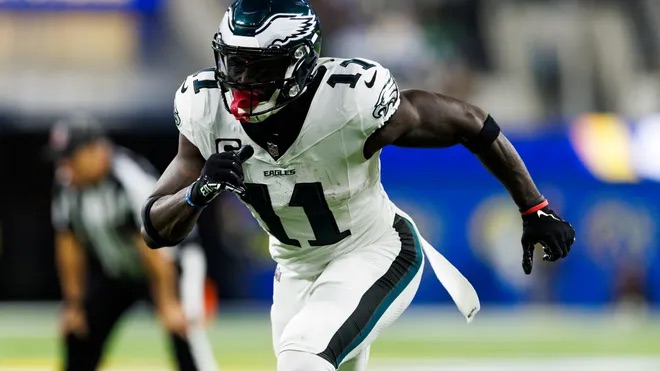
Image courtesy of USATI
The rumors surrounding a potential A.J. Brown trade to the Patriots have reached a fever pitch since the Eagles brought back Dallas Goedert over the weekend, but for a New England front office that just watched their team compete in Super Bowl LX, the price of a first-round pick may be a bridge too far.
While the prospect of pairing Drake Maye with an All-Pro talent is tantalizing, several factors suggest that such a move could disrupt the long-term roster construction Eliot Wolf has carefully prioritized.
One of the most pressing concerns is the impending salary cap burden. Brown is entering his age-29 season and is scheduled to carry a significant cap hit as his $96 million extension begins its most expensive phase in the coming years. New England has roughly $40 million in cap space, but much of that is already earmarked for critical internal moves.
With players like Christian Gonzalez and Drake Maye necessitating long-term financial commitments in the near future, absorbing Brown’s massive salary could force the team to part ways with essential homegrown depth. The recent decision to move on from Stefon Diggs due to his rising cap charge suggests the Patriots are wary of overpaying for aging stars, and Brown would represent an even larger financial hurdle.
Furthermore, the draft capital required to facilitate this trade is exceptionally high. Philadelphia is reportedly holding firm on a demand that includes a first-round pick, a steep price for a receiver who, while productive, saw his yards-per-reception dip to 12.9 in 2025. The Patriots have 11 picks in the upcoming 2026 draft, but they are currently set to pick near the end of the first round. Historically, this front office has preferred to use those late-first-round selections to secure cost-controlled starters at premium positions like tackle or edge rusher.
Moving that pick for Brown would not only forfeit a high-ceiling rookie on a cheap four-year deal but would also limit the team’s ability to address EDGE where finding a long-term answer on either side of the front remains a primary objective.
Finally, the current state of the Patriots’ wide receiver room has become less dire following the addition of Romeo Doubs. By signing Doubs to a four-year deal, New England has already raised the floor of their passing attack, allowing younger players like Demario Douglas and Kayshon Boutte to continue their development in defined roles. The emergence of Boutte as a reliable target during the recent Super Bowl run provides evidence that the team can find high-level production through internal development and strategic free-agency additions.
Rather than depleting their resources for one superstar, the more prudent path for the Patriots may be to continue building a balanced, sustainable roster that supports their young quarterback without mortgaging the future.