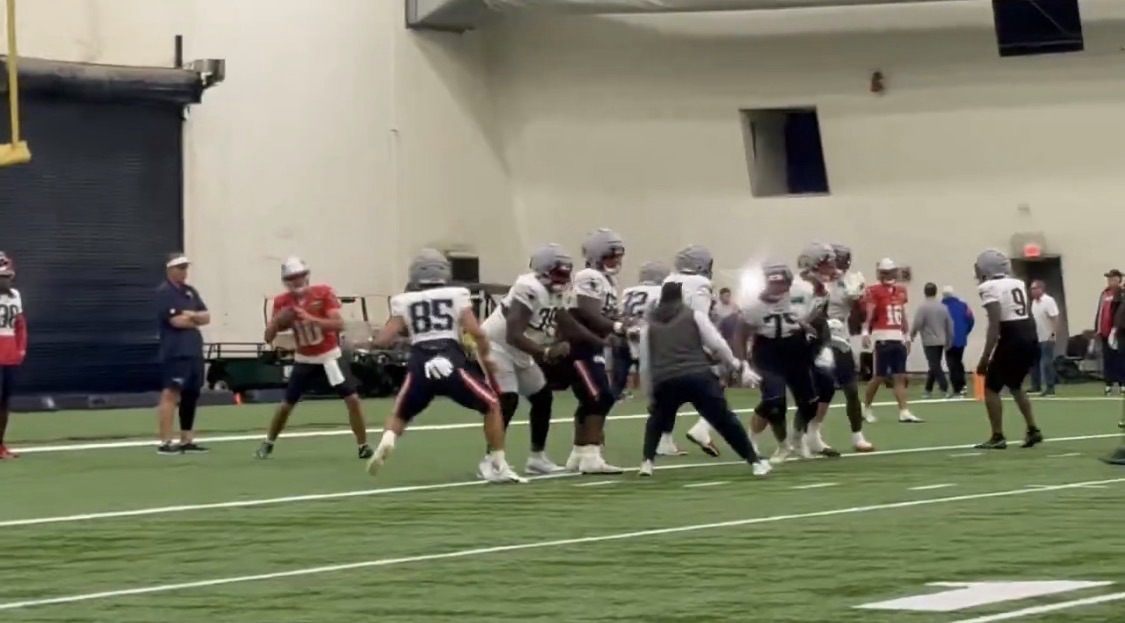
FOXBOROUGH- As defensive coordinators prepare to face Josh McDaniels offense for a second season this time around, the threat of the Patriots going uptempo is always lingering in the back of their minds.
While modern football often equates tempo with high-flying, no-huddle spread offenses that push the pace for four quarters, the Patriots have long viewed tempo through a far more surgical lens: as a strategic change of pace rather than a permanent identity.
For McDaniels, manipulating the speed of the game has never been about running 80 plays a game just for the sake of fatigue; it is about controlling the pace. By shifting into a hurry-up offense at key moments, the offense effectively traps defensive personnel packages on the field. A nickel or dime package designed to stop third-and-long can suddenly find itself forced to defend downhill power runs or quick option routes without the ability to sub in heavier run-stoppers. Conversely, a heavy base defense can get caught back on its heels against quick-game concepts, unable to adjust pre-snap alignment before the ball is snapped.
This use of tempo is deeply rooted in the architecture of the Erhardt-Perkins system or as I call it, the East Coast Offense, which McDaniels has perfected over decades in New England. Because the playbook relies on concise, conceptual language rather than wordy play names, the Patriots can communicate complex adjustments at the line of scrimmage with minimal effort. The quarterback can quickly signal a shift, reset a concept based on what the defense is showing, and get the ball out before the pass rush can set its edge or linebackers can pass off coverage responsibilities.
Patriots Coach Mike Vrabel says the offensive staff has tried to build tempo into the way they operate at practice.
“So, we’ve tried to build those things into practice, and I think it works better when a play gains 8 or 10 yards. If it’s no gain, it’s hard to recreate that. Again, we don’t want to go fast just to go fast. We want to determine whether it can help us, and if it can, great, while also helping the defense. We’ve emphasized not substituting until you see us huddle. If a player steps across the line and we try to get on the ball quickly, they’re going to stand over it. It’s all those little details we can teach the offensive players while making sure the defense is getting back and getting set. Are they going to snap the ball fast and do we need to be lined up? Are they just trying to see what we’re in? We try to talk to everyone involved, because you have to figure out what type of tempo it is, and adjust and disguise accordingly. So, we’ll see. There’s opportunities to do that. We haven’t really gotten into the two-minute situation or at the end of the half yet. That’ll be the next situation that goes in. We’re just trying to build those opportunities through practice as best we can, so the players don’t know they’re coming and the offense can get to the line of scrimmage in a timely fashion.”
We saw this play out across multiple eras of New England football. During the dynasty years, the sudden acceleration into no-huddle was a signature facet of the offense, relentlessly wearing down opposing fronts and exploiting favorable matchups. Even as the system adapted to different personnel—from power-running schemes to diverse passing games—the ability to jump on the gas pedal at a moment’s notice remained a constant threat.
When the Patriots dial up the tempo last week, it wasn’t an experimental gimmick or a departure from their roots; it is a calculated continuation of a proven aspect of the offense. By dictating the rhythm of the game, McDaniels continues to use tempo as the ultimate chess move, keeping defenses guessing, winded, and on their heels.