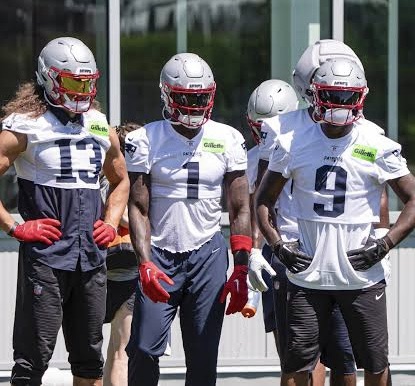
FOXBOROUGH – 11 personnel (one running back, one tight end, and three wide receivers) is the modern NFL’s primary offensive personnel grouping. When executed well, it forces opposing defensive coordinators into constant mismatch dilemmas.
For the New England Patriots, deploying a line package featuring A.J. Brown, Romeo Doubs, Kayshon Boutte, Hunter Henry, and a backfield tandem of Rhamondre Stevenson or TreVeyon Henderson presents a lethal combination of size, vertical threat, option-route intelligence, and backfield power.
At the core of this grouping for the Patriots is the wide receiver trio. A.J. Brown serves as the focal alpha parameter on the outside. His unique combination of physical strength and yards-after-catch capability draws top cornerbacks and immediate safety shading. Complementing Brown, Romeo Doubs provides a versatile option that can line up in all three receiver spots. Meanwhile, Kayshon Boutte’s quickness out of the slot or as a secondary outside option capitalizes on single-high coverage opportunities created when defenses over-commit to Brown.
What elevates this receiving corps beyond mere athleticism is the conceptual demands placed on defensive backs. In Josh McDaniels’ offensive system, receivers must diagnose coverages on the fly and adjust their routes based on leverage and pre-snap pre-read indicators. Speaking on the intricate demands of the system, Brown emphasized the mental sharpness required to make this unit function cleanly.
“This offense is very complex you know and that’s a good thing… A lot more thinking, you know it’s not just sitting over there and you got your route… like the defense come you gotta adjust, you gotta adjust the routes and everything.”
When all three wideouts adjust their stems to exploit defensive voids in real time, secondary communication collapses, leaving nickel cornerbacks and safeties out of position.
The Patriots depth at wide receiver will also allow them to mix and match receivers. Mack Hollins and Pop Douglas will also mix in and get reps with the first three receivers.
While the wide receivers dictate the alignment of defensive backs, veteran tight end Hunter Henry can be targeted in the middle of the field. In 11 personnel, Henry serves as a classic space-eater on intermediate crossing concepts and red-zone seam routes. If defense coordinators opt to stay in lighter nickel or dime packages to cover Brown, Doubs, and Boutte, Henry immediately creates a size advantage against nickel linebackers or third safeties.
The final stress point stems from the choice of backfield partner. Rhamondre Stevenson brings heavy contact balance and downhill power, forcing defenses to keep extra run defenders in the box. If light boxes are presented, Stevenson wears down light nickel fronts. Conversely, incorporating rookie or explosive playmakers like TreVeyon Henderson adds an immediate home-run dynamic in both the gap-scheme run game and the perimeter pass game.
When defenses over-commit to stopping the run, the option-route flexibility of the receiving corps takes over. If they light the box to bracket Brown and double the seams, the backfield controls the tempo on the ground. That constant push-and-pull is precisely what makes this 11 personnel package a nightmare to call plays against. Especially against the Patriots.